Research
In our lab, we study interactions between terrestrial ecosystems,
the global climate system, and other drivers of global change.
We tend to focus on plants, but as many of our colleagues remind us,
we cannot forget about other players in the ecosystem.
We use a combination of empirical studies at multiple scales and modeling to answer our questions.
Through our work, we hope to improve our understanding of how terrestrial ecosystems
regulate climate and global change.
Ultimately, we aim to improve the reliability of future projections of our ever-changing world.
Below is list of some ongoing projects in the lab.
We are always looking to start new collaborations!
Please reach out
if you'd like to collaborate on a project.
IntBio: Defining the mechanisms and consequences of mutualism reorganization in the Anthropocene
Funding: National Science Foundation Integrative Biology (IntBio) program
This IntBio project builds on a LTREB long-term “press” experiment that manipulates exotic plant invasion to address unexplored mechanisms of mutualism reorganization within four AIMS:
- Determine intransient, long-term patterns of AM and pathogenic fungal communities and how they are reorganized by invasion.
- Determine how reorganization of plant-AM fungal mutualisms affects plant physiology at the molecular level.
- Determine the extent to which reorganization of plant-AM fungal mutualisms and/or soil nutrient availability impacts plant performance.
- Experimentally addressing these aims will allow for multimodal integration to scale mutualism reorganization to demography.
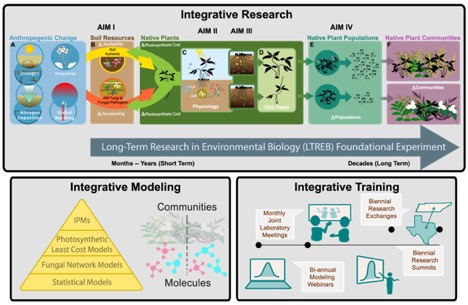
Photo: Aims of the IntBio project.
Improving understanding and prediction of photosynthetic acclimation to global change
Funding: National Science Foundation CAREER program
We are interested in understanding how photosynthesis acclimates to environmental changes, both above- and below-ground. This includes tackling the following questions:
- How do soil nutrients and nutrient acquisition alter acclimation responses?
- What do plants acclimate to and how long does it take?
- How does photosynthetic acclimation alter community- and ecosystem-scale processes?
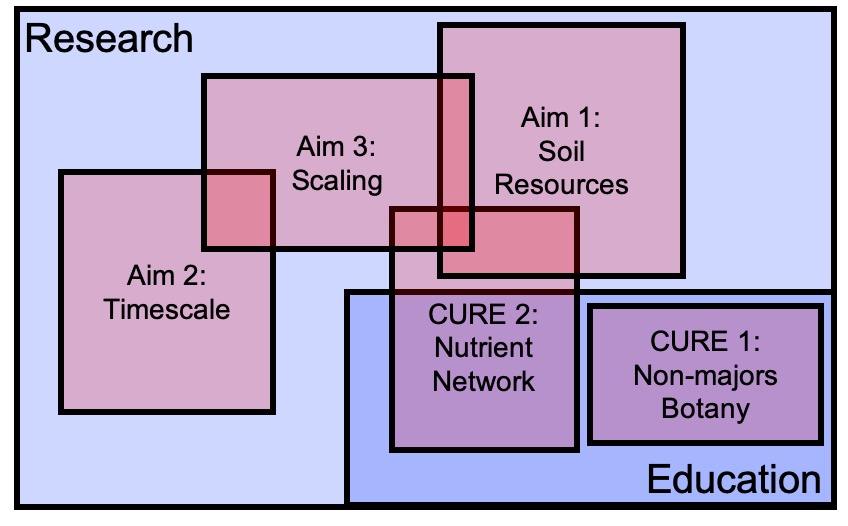
Photo: Aims of photosynthetic acclimation project.
Land Ecosystem Models Based On New Theory, obseRvations, and ExperimEnts (LEMONTREE)
Funding: Schmidt Futures VESRI program
In collaboration with many other institutions, we are working on ways to improve the reliability of land surface model simulations. This large, collaborative project includes modeling groups, remote sensing group, and experimentalists (like us!). We will be working closely with other groups to design experiments that can test and help to develop new theory that can be used to improve land surface models.
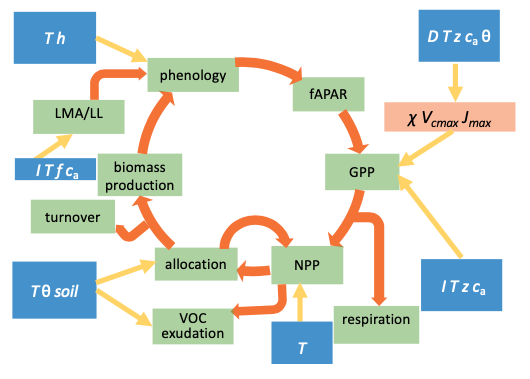
Photo: Models are complex! Out project will help to simplify them and make them more tractable.